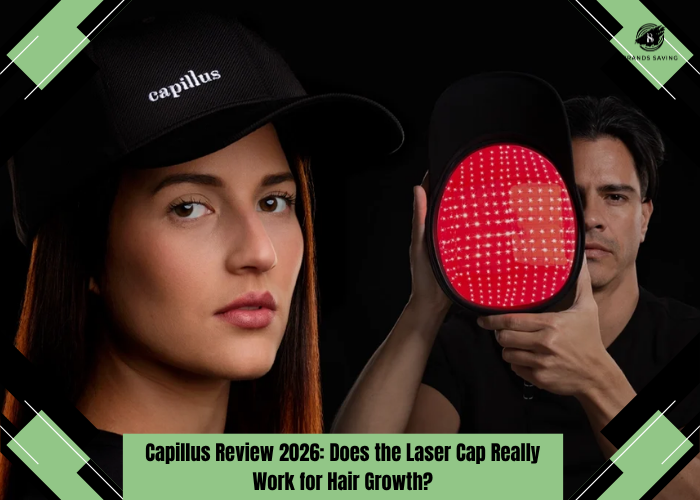
Capillus Review 2026: Does the Laser Cap Really Work for Hair Growth?
Quick Verdict
| Category | Our Take |
| Overall Rating | 8.7/10 |
| Best For | Men and women with pattern hair loss who want a drug-free, at-home LLLT option |
| Technology | Low-level laser/light therapy |
| Capillus PRO | 272 medical-grade laser diodes |
| Daily Treatment | 6 minutes |
| Biggest Strength | Extremely easy treatment routine |
| Biggest Drawback | High upfront cost |
| Return Window | 6-month satisfaction guarantee on laser devices |
| Customer Feedback | 4.5/5 TrustScore on Trustpilot at review time |
Capillus Review: Can a Six-Minute Laser Cap Really Help With Hair Loss?
Hair loss products have a credibility problem. Search for a solution to thinning hair and you'll quickly encounter miracle shampoos, gummies, oils, serums, red-light helmets and suspicious before-and-after photographs.
Capillus immediately stands out for another reason: the price.
Its current PRO costs $1,699, while more advanced Capillus devices climb to $2,699 and $3,299. That's serious money for something that looks, from the outside, like an ordinary baseball cap. So naturally, shoppers want to know: Does Capillus work?
The answer requires more nuance than either “yes” or “no.”
Capillus uses low-level laser therapy, commonly abbreviated LLLT. This isn't an imaginary technology invented solely for selling expensive caps. Photobiomodulation and low-level light therapy have been studied for androgenetic alopecia, and FDA-cleared home devices exist within the category. Capillus also offers advantages that matter enormously in real life: no messy topical application, no complicated setup and a treatment session lasting only six minutes. But FDA clearance doesn't mean guaranteed regrowth, and a successful clinical study doesn't guarantee the same result for every buyer. In this Capillus laser cap review, we'll separate those two ideas and examine the PRO, other current models, evidence, usability, prices, customer feedback and competing devices.
Check Today's Price
What Is Capillus?
Capillus is a U.S.-based brand specializing in wearable laser and red-light devices. Its best-known products are hair-regrowth caps. Instead of making you sit beneath a large helmet or hold a light device against different areas of your scalp, Capillus embeds laser diodes inside a flexible dome worn underneath a baseball cap. The concept is clever because it makes treatment almost passive. Put on the cap, connect the battery and complete the prescribed session while you're doing something else.
Capillus says its devices are FDA cleared, and its products are assembled and serviced in the United States in an ISO 13485-certified facility. The company currently sells several hair devices rather than one universal cap. The lineup includes the PRO, PRO S1, PRO S2, Spectrum and TriSpectrum, among other products. For most buyers, however, the Capillus PRO is the logical starting point.
How Does the Capillus Laser Cap Work?
The basic concept behind Capillus is photobiomodulation. Red light at specific wavelengths is delivered to the scalp, where it is intended to stimulate biological activity in hair follicles. For people with androgenetic alopecia better known as male- or female-pattern hair loss the goal isn't to manufacture brand-new follicles. It's to support follicles that are still present but producing progressively finer, shorter hairs. This distinction matters. A laser cap isn't comparable to a hair transplant.
If a scalp area has been completely bald for years and viable follicles are no longer present, expectations should be considerably lower. Capillus emphasizes that its hair caps use laser diodes rather than conventional LEDs. The company argues that lasers deliver more targeted penetration while LEDs disperse light more broadly. The current PRO places 272 medical-grade laser diodes across its interior dome to distribute light over thinning areas.
Is There Scientific Evidence for Laser Hair Growth?
This is one of the most important parts of any responsible Capillus review. Low-level light therapy isn't merely a marketing concept. Clinical research supports its potential role in androgenetic alopecia. More recent randomized controlled research also continues to investigate light-based caps. For example, a 2025 multicenter, randomized, double-blind controlled study evaluated different red and blue light configurations against a sham device over 26 weeks. That doesn't mean every device has identical evidence. Capillus specifically says a clinical study of the PRO found an average 51% increase in hair count after 17 weeks of daily treatment, without reported side effects in that study.
That's encouraging. But it's important to interpret percentages correctly. A 51% increase in measured hair count within a defined study area isn't the same as saying your entire head will suddenly contain 51% more cosmetically visible hair. Individual response can depend on the type and progression of hair loss, age, adherence and other factors.
So our evidence-based conclusion is: LLLT is credible enough to consider for appropriate pattern hair loss, but it isn't a guaranteed cure.
Capillus PRO Review
The Capillus PRO is probably the model most readers researching Capillus PRO reviews will encounter. It currently contains 272 medical-grade laser diodes and costs $1,699. The headline feature isn't really the laser count, though. It's the treatment time.
Six Minutes Per Day
Capillus PRO sessions take just six minutes daily. The device automatically shuts itself off when the treatment is finished, eliminating the need to run a timer. That sounds like a minor convenience until you consider that hair-loss treatments typically require months or years of consistency. Compliance matters. A theoretically excellent treatment you repeatedly forget to use isn't particularly useful. Six minutes while checking email, drinking coffee or getting dressed is easy to incorporate into most routines. That's one of the strongest arguments for Capillus.
272 Laser Diodes
The PRO uses 272 lasers distributed around the interior dome. Higher diode counts can provide denser coverage, but buyers shouldn't reduce their entire purchasing decision to “more lasers = more hair.” Coverage, wavelength, energy delivery, fit and actual treatment protocol all matter. Still, 272 diodes puts the PRO firmly into premium-device territory.
Maximum Scalp Coverage
Capillus places the diodes across the dome to cover common areas of thinning rather than requiring users to reposition a handheld device repeatedly. This is particularly convenient for diffuse thinning across the crown and top of the scalp. Fit matters, however. Capillus provides a sizing guide because the cap needs to sit correctly for appropriate light positioning.
Capillus PRO S2: Is the Upgrade Worth It?
The PRO S2 steps things up to 308 medical-grade laser diodes. It also adds Bluetooth connectivity, allowing the device to connect with the Capillus app for treatment and progress tracking. At the time of this review, Capillus lists the PRO S2 at a sale price of $1,799, reduced from $2,399. That creates an interesting situation. At regular pricing, the premium over the PRO is substantial.
At the current $1,799 promotional price, the difference from the $1,699 PRO is only $100. In that scenario, the additional diode coverage and app functionality make the S2 easier to justify. Pricing changes, though, so compare the two on the day you purchase.
Capillus Spectrum and TriSpectrum
Capillus has expanded beyond single-wavelength products. The current Spectrum offers 312 laser diodes plus near-infrared technology and costs $2,699. The TriSpectrum also uses 312 medical-grade laser diodes and is currently priced at $3,299. These are luxury-level investments. Unless you specifically want the additional wavelength technology and have the budget, we think the PRO remains the more rational starting point for many buyers. The price difference is simply too large to ignore.
First Impressions: Surprisingly Normal—and That's Good
Most laser hair devices look medical. Capillus deliberately doesn't. The laser dome sits beneath what resembles a conventional baseball cap. That makes it considerably less conspicuous than a large illuminated helmet. At home, appearance may not matter. But discreet design still makes the device easier to live with. Setup is also straightforward. Charge or connect the battery system, position the dome correctly, put the cap on and start your session. There are no gels to apply and no device that needs to be manually moved around the scalp. The automatic six-minute shutoff means the treatment effectively manages itself. The experience is therefore much closer to wearing a hat than undergoing a complicated hair procedure. That's exactly what an at-home treatment should feel like.
Real-World Experience: Where Capillus Makes Sense
Convenience Is Its Biggest Advantage
The strongest part of Capillus isn't a flashy technical specification. It's adherence. Hair-loss treatment requires consistency. Topical treatments can be messy. Some oral medications require medical oversight and carry potential adverse effects. Clinical procedures require appointments. Capillus asks for six minutes. For someone committed to long-term hair maintenance, that is remarkably manageable.
Results Require Patience
Do not purchase a Capillus cap expecting a visible transformation after two weeks. Hair grows slowly. Even Capillus' highlighted PRO study measured results after 17 weeks. Realistically, this is a months-long experiment rather than an instant treatment. Consistent photographs taken under the same lighting, angle and hairstyle are a better way to evaluate progress than checking the mirror every morning.
It Won't Address Every Cause of Hair Loss
This is the most important limitation. Pattern hair loss is only one explanation for thinning. Hair can also shed because of iron deficiency, thyroid disorders, medications, significant stress, autoimmune disease, postpartum changes and other causes. A laser cap doesn't diagnose any of them. That's why spending $1,699 before understanding why your hair is thinning can be a costly mistake.
Does Capillus Work Without Minoxidil?
Potentially, depending on the individual and type of hair loss. LLLT can be used as a standalone modality, but dermatologists may also combine treatments because they act through different mechanisms. That could mean laser therapy alongside topical or oral therapies when medically appropriate. This isn't necessarily an either/or decision. For buyers who dislike topical minoxidil because of application inconvenience, Capillus has obvious lifestyle appeal. But anyone considering prescription hair-loss medication should discuss options and risks with a qualified clinician rather than replacing medical guidance with a device review.
Capillus Pricing & Value Analysis
Capillus is expensive. There's no reason to soften that conclusion. Current pricing includes:
| Model | Current Listed Price* | Key Specification |
| Capillus PRO | $1,699 | 272 laser diodes |
| Capillus PRO S2 | $1,799 sale | 308 laser diodes + Bluetooth |
| Capillus Spectrum | $2,699 | 312 lasers + near-infrared |
| Capillus TriSpectrum | $3,299 | 312 lasers, tri-wavelength technology |
*Prices checked August 2026 and can change.
Is $1,699 Too Much?
For a casual experiment? Yes.
For someone already spending substantial money on long-term hair treatments and who specifically wants a drug-free home device? Potentially not.
Unlike consumable treatments, you're purchasing hardware that can be repeatedly used. Capillus products are also currently listed as HSA/FSA eligible, which can improve the effective cost for eligible U.S. customers using pre-tax funds.
Six-Month Satisfaction Guarantee
Capillus states that its laser devices can be returned for up to six months after purchase. That's particularly valuable for a hair-growth device because meaningful results aren't expected overnight. However, read the complete current return and warranty conditions before ordering. BBB complaints include disputes involving return fees and warranty coverage, including a 2026 complaint about a battery pack that the customer said was covered for a shorter period than the cap itself. A complaint doesn't independently prove wrongdoing, but it highlights why the fine print matters on an expensive device.
Explore BRAND Collections
Capillus Pros & Cons
| Pros | Cons |
| FDA-cleared technology | $1,699+ is a major investment |
| Just six minutes daily with PRO | Hair regrowth isn't guaranteed |
| 272 laser diodes on PRO | Requires months of consistent use |
| Hands-free treatment | Not appropriate for every type of hair loss |
| Discreet baseball-cap design | Higher models become extremely expensive |
| No messy topical application | Fit/sizing matters |
| Clinical evidence supporting LLLT category | Some complaints about hardware/battery issues |
| Capillus cites a clinical study on PRO | Warranty details need careful reading |
| Six-month laser-device return period | Evidence shouldn't be interpreted as guaranteed individual results |
| HSA/FSA eligible devices | May still need other hair-loss treatments |
Who Should Buy a Capillus Laser Cap?
Capillus makes the most sense for someone who has already established that their thinning is compatible with a condition for which low-level laser therapy is appropriate. It's particularly appealing to people who prioritize convenience. If you've abandoned other treatments because they were messy or difficult to incorporate into your routine, six minutes per day is a significant advantage. Capillus may also appeal to people seeking a non-drug option or an additional modality alongside a dermatologist-directed hair-loss plan.
| Buyer | Recommendation |
| Men with pattern thinning | Strong Candidate |
| Women with pattern thinning | Strong Candidate |
| Buyers wanting drug-free LLLT | Recommended |
| People struggling with treatment consistency | Excellent Convenience |
| Buyers wanting discreet devices | Recommended |
| Unexplained sudden hair loss | See a clinician first |
| Long-established completely bald areas | Lower expectations |
| Budget-conscious buyers | Compare alternatives |
Who Should Avoid Capillus?
Don't buy Capillus simply because you've noticed more hair in the shower. Sudden or unexplained shedding deserves medical evaluation. Likewise, people experiencing patchy loss, scalp inflammation or other unusual symptoms should seek professional assessment rather than assuming androgenetic alopecia. Capillus is also difficult to justify for someone who knows they won't use it consistently. A $1,699 device sitting in a drawer has zero practical value. Finally, shoppers expecting guaranteed restoration of a youthful hairline should recalibrate expectations. LLLT can support hair growth in appropriate candidates; it cannot guarantee that every follicle will recover.
Capillus Reviews: What Do Customers Say?
Independent customer feedback is broadly positive, although it requires careful interpretation. Trustpilot currently shows 1,619 Capillus reviews and a 4.5/5 TrustScore. Seventy percent are five-star reviews, while 12% are one-star reviews. The strongest recurring theme isn't actually hair growth. It's customer service. Recent reviewers frequently praise staff for answering questions, arranging repairs and helping replace components. Trustpilot's summary similarly highlights knowledgeable and attentive service. That's reassuring when buying expensive electronics. But negative feedback deserves equal attention.
Some customers report delays in communication, difficulty obtaining replacement batteries or devices failing over time. BBB complaints also include buyers who say they used a Capillus device consistently without seeing the expected hair improvement. Others report disputes involving batteries, refunds or warranty conditions. Those reports don't establish that the device generally doesn't work.
They establish something more realistic: results and ownership experiences vary. That is precisely what we'd expect from both hair-loss treatment and consumer electronics.
Capillus vs HairMax vs iRestore
The laser-cap market has several established competitors. The exact model specifications and prices change frequently, so buyers should verify current details before purchasing, but the strategic differences are relatively clear.
| Feature | Capillus | HairMax | iRestore |
| Main format | Baseball-style laser cap | LaserBand / caps | Helmet-style systems |
| Treatment convenience | Excellent | Good–Excellent | Good |
| Capillus PRO session | 6 min/day | Model dependent | Model dependent |
| Discreet appearance | Excellent | Varies | Lower |
| Premium pricing | High | Moderate–High | Moderate–High |
| FDA-cleared options | Yes | Yes | Yes |
| Best reason to buy | Convenience + discreet design | Range of formats/prices | Helmet coverage/value |
| Main drawback | Price | Treatment differs by model | Less discreet |
Capillus vs HairMax
HairMax is one of the longest-established names in consumer laser hair devices and offers different physical formats. The choice often comes down to usability. Capillus feels more like putting on a normal hat. HairMax can make more sense if you prefer its specific device format or find a comparable model at a significantly lower price.
Capillus vs iRestore
iRestore's helmet-style approach is visually more obvious but can provide a more value-oriented path into light therapy depending on the model and promotion. Capillus wins on discretion. If you care about being able to move around wearing what looks like a baseball cap, that's a genuine advantage. If you only plan to use the device privately while watching television, paying extra for discretion becomes less important.
Frequently Asked Questions
Does Capillus work?
Capillus uses low-level laser therapy, a technology with clinical evidence supporting its use for certain cases of androgenetic alopecia. Capillus also cites a PRO study showing an average 51% hair-count increase after 17 weeks. Individual results are not guaranteed.
Is Capillus FDA approved?
The more accurate term is FDA cleared for the relevant devices/indications, rather than “FDA approved.” Capillus identifies its laser-cap technology as FDA cleared.
How long does Capillus take to work?
Expect months rather than weeks. Capillus' highlighted PRO clinical result was measured after 17 weeks of daily treatment.
How often do you use a Capillus laser cap?
The current Capillus PRO protocol is six minutes per day. The device automatically shuts off when the session is complete.
Is Capillus worth it?
Capillus is worth considering for an appropriate candidate who values convenience and can comfortably afford the high upfront cost. Budget-focused buyers should compare competing FDA-cleared LLLT devices.
How much does Capillus PRO cost?
The Capillus PRO is currently listed at $1,699. Prices and promotions can change.
What's the difference between Capillus PRO and PRO S2?
The PRO has 272 laser diodes. The PRO S2 has 308 medical-grade laser diodes plus Bluetooth connectivity for app-based tracking.
Can women use Capillus?
Yes. The Capillus PRO is marketed for both men and women experiencing appropriate forms of hair thinning.
Can Capillus regrow completely bald areas?
Expectations should be conservative where follicles are no longer viable. Laser therapy is better suited to thinning areas with functioning follicles than restoring long-established completely bald scalp.
Can I use Capillus with minoxidil?
Combination treatment may be appropriate for some people, but treatment decisions should be discussed with a dermatologist or other qualified healthcare professional.
Does Capillus have a money-back guarantee?
Capillus currently advertises a six-month satisfaction guarantee for its laser devices. Read the complete current terms before ordering.
Is Capillus safe?
Capillus markets its hair devices as FDA cleared, and the company says its PRO clinical study reported no side effects. Individual circumstances vary, so follow device instructions and seek medical advice if you have a scalp or medical condition.
Final Verdict: Is Capillus Worth It in 2026?
After examining the technology, specifications, current prices, clinical claims and independent Capillus reviews, we think the brand occupies an interesting position in the hair-loss market. It isn't snake oil. But it isn't magic either. Low-level laser/light therapy has legitimate scientific support as an option for androgenetic alopecia, and Capillus packages that technology into one of the easiest routines we've encountered. The PRO's biggest selling point isn't 272 lasers. It's six minutes per day. That simplicity matters because hair-loss treatments only have a chance to help when people actually follow the protocol. The baseball-cap design is another practical advantage. It looks far less clinical than many helmet-style alternatives.
Then we reach the problem: $1,699.
At that price, Capillus isn't an impulse purchase. We strongly recommend determining the cause of your hair loss first. Spending four figures on LLLT makes considerably more sense after a dermatologist confirms that you're a reasonable candidate. We'd also compare models carefully. At the prices available during this review, the PRO S2's $1,799 promotional price puts it only $100 above the standard PRO while increasing the diode count from 272 to 308 and adding Bluetooth tracking. The $2,699 Spectrum and $3,299 TriSpectrum are much harder to recommend universally. Independent feedback adds reassurance but also perspective. Capillus currently holds a strong 4.5/5 TrustScore on Trustpilot, particularly for customer service, while negative reviews and BBB complaints show that hardware problems, warranty disagreements and disappointing hair results do occur
Shop BRAND Now
At BrandsSaving, we are dedicated to helping you shop more intelligently, spend more judiciously, and find superior value online. Regardless of whether you are a student, a parent, a fashion enthusiast, or just a sensible shopper, we link you to dependable savings opportunities and trustworthy buying options from your preferred brands across the globe
Subscribe
Sign up below to receive money-saving tips, frugal ideas, family-friendly recipes, and more.