
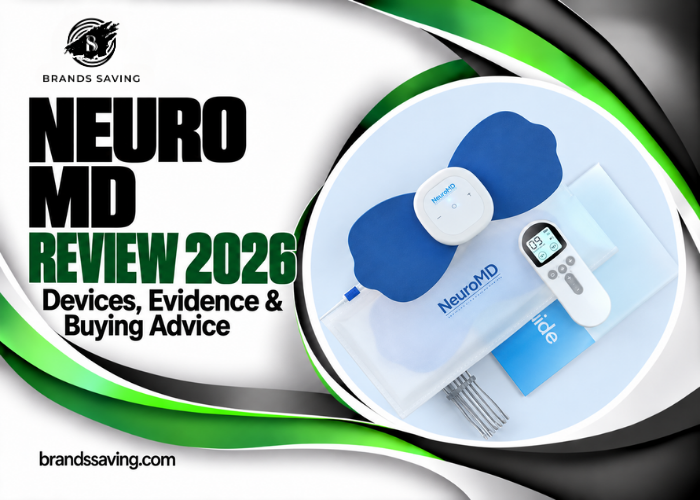
An electrical stimulation device can look like an appealing way to manage persistent discomfort at home. The difficult question is whether the particular device fits your condition, rather than whether its advertising sounds convincing. This NeuroMD review examines the back-focused device, Whole Body Corrective Therapy Device 2.0, and Foot & Lower Leg device, alongside the evidence and ownership costs that matter before buying.
NeuroMD’s appeal is understandable: compact equipment, remote controls, and structured sessions that fit into a home routine. However, convenience is different from clinical effectiveness. Back pain, sciatica, and foot symptoms can have different causes, so a device advertised across several conditions cannot be assumed to address each one equally well. A useful review needs to separate the hardware from the health promises.
This is a research-based review of official product information, published studies, safety guidance, and purchase terms, checked on October 14, 2026. We have not tested the devices or independently measured their output. The buying recommendation is therefore conditional: consider NeuroMD only when the exact device is appropriate for your situation and you understand the limits of the evidence. It should complement suitable care rather than become a reason to postpone assessment.
NeuroMD at a Glance
Quick verdict: A convenience-focused option for adults considering home electrical stimulation with professional guidance. The main reservations are uncertain product-specific effectiveness and return conditions that deserve attention.
Best for: Someone with an assessed problem, a clinician-supported reason to try stimulation, and realistic expectations about comfort and function.
Advantages: Portable designs, remote operation, and different formats. Limitations: Consumable costs, contraindications, and research that does not establish a universal result for these exact devices.
Rating: Not assigned. A numerical effectiveness score would overstate what a research-only review can establish.
Compare the Device Before the Promise
Review the exact model and discuss its suitability with your clinician before choosing a kit.
Explore NeuroMD Device Details →What Is NeuroMD?
NeuroMD sells home electrical stimulation equipment under the “Corrective Therapy” name. Its official catalog includes back, whole-body, and foot-and-leg formats, plus replacement components. This review focuses on those devices rather than unrelated products sold through the store. A shared brand name does not mean every item has the same controls, intended use, or supporting research.
The term “corrective” deserves careful interpretation. It is a product name, not evidence that stimulation repairs a damaged disc, removes nerve compression, or resolves the underlying cause of every painful condition. A more useful purchasing question is whether the proposed stimulation is appropriate and whether the design makes it practical to use. That keeps the evaluation tied to an identifiable need instead of an expansive promise.
NeuroMD vs TENS Unit: What Is the Difference?
TENS stands for transcutaneous electrical nerve stimulation and is commonly used for pain modulation. NMES means neuromuscular electrical stimulation and is intended to stimulate muscle contractions. They have different purposes, although combination devices can provide both. The Whole Body 2.0 support description identifies it as an NMES-and-TENS system, so the comparison is more nuanced than NeuroMD versus all TENS technology.
For buyers, the important distinction is the desired outcome. A sensation during treatment does not establish improved strength, and a muscle contraction does not prove that the source of pain has been corrected. Ask what function the prescribed mode is supposed to support and how improvement will be assessed. A device with more programs may offer flexibility, but program count alone says little about suitability.
The evidence for TENS also depends on the condition. NICE’s low-back-pain and sciatica guideline advises against offering TENS for that indication. This does not directly evaluate every NeuroMD NMES mode, nor does it establish that NMES must be superior. It does mean that a general pain-relief claim should not be treated as a condition-specific recommendation.
Key Features and Product Range
The Back-Focused Corrective Therapy Device
The back-device listing describes a rechargeable remote, gel electrodes, and an accompanying recovery and exercise program. Its more focused format may appeal to someone who prefers a simpler routine over a broad menu of settings. That simplicity can reduce decision-making, but it cannot replace appropriate assessment or correct placement.
Before choosing this model, consider whether you can reach the treatment area and handle the pads comfortably. Limited shoulder movement or hand dexterity can make an apparently simple task inconvenient. A remote helps with controls once the device is attached; it does not necessarily solve the placement problem. Ask for a demonstration or examine the setup instructions before ordering.
NeuroMD Whole Body Corrective Therapy Device 2.0 Review
The Whole Body 2.0 listing describes wireless pods, a shared remote, and 23 modes. Packages offer different numbers of pods, with one remote controlling up to six. Its broader configuration is the main practical distinction for someone considering several approved treatment areas. More hardware is useful only when there is a specific reason to use it.
“Whole body” should not be read literally as permission to place electrodes anywhere. The product name describes versatility, while the manual determines permitted locations and procedures. Compare the controls and accessories with the older back device rather than assuming that replacement parts cross over. An upgrade should solve a real limitation in your routine, not simply introduce more settings to manage.
NeuroMD Foot and Lower Leg Device Reviews: A Different Format
The Foot & Lower Leg device uses a foot mat, rechargeable device, and remote. A mat-based arrangement may be easier to incorporate into seated use than positioning adhesive pads, depending on your abilities. Its marketing includes circulation and neuropathy claims, but these should not be treated as proof of nerve repair or disease treatment.
The listing contains differing session-duration descriptions, including 20, 25, and 30 minutes. We would follow the supplied model-specific instructions and clarify inconsistencies with support rather than choose a protocol from the sales copy. People with numb feet or unexplained swelling need particular caution: reduced sensation can make self-directed intensity changes difficult to judge. A foot mat is not a diagnostic tool.
| Format | Main buying distinction | Question to settle first |
|---|---|---|
| Back device | Focused routine using adhesive electrodes. | Can you place and maintain the pads reliably? |
| Whole Body 2.0 | More modes and expandable pod configuration. | Which approved areas actually require treatment? |
| Foot & Lower Leg | Seated foot-mat arrangement. | Has the cause of your symptoms been assessed? |
First Impressions and Setup: What the Design Suggests
The listings show compact consumer-oriented equipment rather than a large clinical machine. This makes home storage and remote operation part of the appeal. We cannot report an unboxing experience, judge packaging quality, or claim that the controls feel intuitive in practice. Those details would require handling the exact kit, and published photos are not a substitute for that experience.
The useful preparation is practical: inspect the instructions, identify the required components, and understand how charging and electrode replacement work. For the pad-based models, skin contact and access to the application area matter. For the mat, the seated arrangement must be stable and accessible. A device that is awkward to prepare may be used less consistently, even if the electronics perform as intended.
Does NeuroMD Really Work? Evidence and Everyday Expectations
Muscle Stimulation Has Research; Product Claims Need Their Own Proof
A 2011 study by Coghlan and colleagues reported improved indicators of deep stabilizing-muscle performance and self-reported pain following NMES training in people with chronic low back pain. This supports investigating the approach, but it does not establish the effectiveness of a current retail NeuroMD kit. The study’s intervention, population, and measurements need to match the claim being made.
Importantly, NeuroMD’s own back-device page acknowledges that its cited studies concern NMES or electrical muscle stimulation rather than trials of the NeuroMD device. Some also combine stimulation with exercise. That disclosure is useful because it prevents a plausible mechanism from being mistaken for a demonstrated product result. “Clinically studied technology” and “this device produced this outcome in a controlled trial” are different statements.
For a buyer, the evidence gap changes the recommendation from confident endorsement to a conditional trial. It is reasonable to discuss stimulation with a clinician when it suits an assessed problem. It is less reasonable to assume the purchase will repair tissue or eliminate the need for other care. Changes in symptoms can have several explanations, particularly when exercise, medication, and activity also change.
Judge Practical Benefit Through Function
If your clinician agrees that a trial is appropriate, agree on what improvement would make it worthwhile. That might involve tolerance for a familiar activity or a meaningful change in everyday comfort. Avoid using stronger stimulation as a proxy for progress. The question is whether the overall plan helps, with acceptable burden and adverse effects, rather than whether the device feels powerful.
Record observations consistently enough to distinguish a useful pattern from a good afternoon. Include difficulty with setup, discomfort, skin reactions, and whether the routine is sustainable. An advertised timeline should not become a reason to continue despite problems. Review persistent or worsening symptoms with a professional instead of escalating settings or buying additional pods.
NeuroMD Sciatica Reviews Need Careful Interpretation
Sciatica searches often mix stories about back discomfort, radiating leg pain, and other diagnoses. A testimonial cannot show that the writer had the same condition or that the device resolved nerve compression. Even a sincerely reported improvement is an individual experience, not a forecast for the next buyer. A reassuring review should never substitute for understanding why the symptoms are happening.
The NHS back-pain guidance advises emergency assessment for warning signs including bladder or bowel changes, loss of sensation around the genitals or anus, and symptoms affecting both legs. These are reasons to seek urgent medical help, not begin a home-device experiment. The potential convenience of stimulation becomes relevant only after the urgent clinical question is addressed.
Pricing and Value for Money
Prices checked on October 14, 2026, were $149.95 for the back device, $179.95 for a one-pod Whole Body 2.0 kit, and $119.95 for one Foot & Lower Leg kit. Larger Whole Body configurations displayed $229.95 for two pods, $279.95 for four, and $319.95 for six, each with one remote. These are listing snapshots; verify your chosen variant and checkout total before purchasing.
Our value assessment centers on suitability and usable convenience. A lower cost per pod can look attractive without making the larger purchase useful. Start by identifying how many approved treatment areas you actually need to address. Compare the total with other suitable options, including the cost of professional assessment, rather than allowing a crossed-out price to determine the decision.
The Trial Has Conditions and Costs
The shipping and returns policy specifies 60 days from delivery, a 30-day minimum trial, and a required return label costing $8.95. Opened returns incur a 15% fee; unopened returns incur 10%, plus shipping costs. It also states bundle sales receive store credit only. Confirm how that restriction applies to the selected multi-device offer before ordering.
Separate try-before-you-buy offers can involve automatic billing after their stated trial period. Replacement parts and accessories are listed as final sale. The policy also describes a one-year limited device warranty, with conditions. Save the terms for your particular order: an advertised trial is not the same as a cost-free experiment, and warranty coverage is not an effectiveness guarantee.
Recurring electrode costs deserve a place in your budget, even without assuming a particular replacement schedule. Adhesive performance depends on use and care, so calculate ownership cost from your actual requirements rather than an optimistic lifespan. We have not verified a coupon code and would not present one as working. A modest purchase with clear terms can be better value than a larger promotional bundle.
Check the Complete Cost Before Choosing a Kit
Compare the selected package, replacement supplies, and written refund eligibility before deciding whether a trial makes sense.
Check NeuroMD Kits and Current Offers →NeuroMD Pros and Cons
| Potential advantages | Limitations to weigh |
|---|---|
| Portable equipment with remote operation. | Placement and accessibility still affect convenience. |
| Different device formats for different routines. | The right format depends on assessed needs. |
| Electrical stimulation has published research. | Technology research does not establish current product effectiveness. |
| A defined home-trial policy. | Fees, timing requirements, and bundle restrictions apply. |
| Consumables and replacement components are sold separately. | Compatibility and recurring costs need checking. |
Who Should Consider NeuroMD?
The most plausible buyer is an adult whose symptoms have been assessed and whose clinician considers home stimulation a reasonable adjunct. That person should understand the proposed goal, have a workable setup routine, and accept that benefit is uncertain. NeuroMD’s convenience could matter when the alternative is equipment that is difficult to place or manage. Convenience is still a personal fit question, not a universal brand advantage.
Choose the smallest configuration that meets an identified need. A focused routine may favor the back device; broader flexibility may justify considering 2.0; a seated mat may suit an appropriate foot-and-leg plan. None should be chosen solely because a testimonial mentions the same symptom word. The decision should connect a known problem, suitable equipment, and acceptable ownership terms.
| Buyer situation | Recommendation |
|---|---|
| Assessed need and clinician-supported stimulation trial | Compare the appropriate model and full terms. |
| Several intended treatment areas | Check whether 2.0 adds useful flexibility. |
| Unexplained pain, numbness, or swelling | Seek assessment before purchasing. |
| Expectation of guaranteed correction or cure | Do not buy on that assumption. |
Who Should Avoid It or Seek Advice First?
NeuroMD’s contraindication guidance identifies important restrictions. Electronic implants such as pacemakers are a major concern. Pregnancy, heart conditions, epilepsy, recent surgery, and other medical circumstances require appropriate professional guidance; the complete model-specific instructions remain essential. Do not infer safety from the fact that the device is sold directly to consumers.
The guidance also restricts use on unsuitable skin and during sleeping, driving, or bathing. People who cannot reliably feel, inspect, or monitor the application area should discuss that limitation before use. A buyer seeking a replacement for diagnosis, rehabilitation, or prescribed treatment should skip that premise. The product’s availability does not settle whether it is safe or useful for an individual.
Customer Feedback: Useful Observations, Limited Proof
The visible Whole Body 2.0 feedback includes reports of improved comfort and appreciation of wireless use, alongside partial relief and concerns about pad adhesion. The back-device comments also include difficulty applying the equipment without assistance. These are observations from seller-hosted reviews, not an independently recruited sample. We did not verify the reviewers’ diagnoses, routines, or long-term outcomes.
Use NeuroMD reviews to identify practical questions rather than calculate a personal success probability. Pay attention to the exact model, treatment duration, and whether the person also changed other care. A positive story may be sincere while leaving the cause of improvement uncertain. Similarly, a disappointing experience can reveal a useful limitation without proving that no one benefits.
When reading NeuroMD back pain relief device reviews or corrective therapy device reviews, look for specifics about controls, setup, supplies, and service. Those details are more transferable than a dramatic recovery story. Independent feedback would strengthen the picture, but a limited verified sample should be described honestly. There is no basis here for inventing a consensus across review platforms.
Competitor Comparison: Compare Approaches Before Brands
The relevant alternatives are not all interchangeable gadgets. A conventional TENS unit prioritizes a different stimulation purpose, while a combined TENS/EMS device may provide adjustable settings and different controls. Clinician-guided rehabilitation offers assessment and progression rather than merely a stimulation session. The most useful comparison begins with that difference in role.
| Option | Main proposition | Trade-off |
|---|---|---|
| NeuroMD back device | Focused home routine and remote operation. | Product-specific outcome evidence remains limited. |
| NeuroMD Whole Body 2.0 | Combination stimulation with expandable configuration. | More settings and hardware may be unnecessary. |
| Conventional TENS unit | Pain-modulation approach. | NICE advises against TENS for low back pain or sciatica. |
| Other TENS/EMS combination device | Potential flexibility in controls and programs. | Verify intended use, instructions, and individual suitability. |
| Clinician-guided rehabilitation | Assessment and an individualized management plan. | Time, access, and costs vary. |
We have not tested named competitors side by side and would not rank their output or durability from specification sheets. A defensible comparison needs matched intended uses, safety instructions, consumables, and purchase conditions. The cheapest device is not automatically the best value, but a premium also needs a concrete justification. Pay for features that support a suitable routine, not a stronger medical promise.
Frequently Asked Questions
Is NeuroMD legit?
NeuroMD operates an online store with identifiable products, support information, and written purchase terms. That supports treating it as a real retailer, but does not independently establish every therapeutic claim. Judge the exact device, relevant evidence, and order conditions separately.
Does NeuroMD really work?
Electrical muscle stimulation has published research, but that does not establish the result of a current NeuroMD kit for every condition. Its back-device page identifies the cited research as studies of stimulation approaches rather than trials of the device itself. Discuss suitability and realistic goals with a clinician.
How does NeuroMD compare with a TENS unit?
NMES is intended to stimulate muscle contractions, while TENS is commonly used for pain modulation. Whole Body 2.0 combines both. Different purposes do not establish that one device is universally better; compare the intended mode with the problem being assessed.
Is NeuroMD proven to cure sciatica?
The evidence reviewed does not establish that NeuroMD cures sciatica or removes nerve compression. Customer improvement stories cannot demonstrate a cure. Radiating pain, weakness, or numbness deserves appropriate assessment, and urgent warning signs require prompt medical attention.
Which NeuroMD device should I choose?
Consider the format that fits a clinician-supported purpose: the focused back device, more flexible Whole Body 2.0, or seated foot-mat arrangement. Review placement, controls, and accessories before choosing. A larger package is useful only when its extra equipment meets a real need.
Can the Foot & Lower Leg device repair neuropathy?
We did not establish product-specific proof that it repairs damaged nerves or resolves the cause of neuropathy. The brand makes symptom-related claims, but numbness and foot discomfort can require a different management plan. Seek advice before using stimulation where sensation is impaired.
Who should not use NeuroMD?
Electronic implants such as pacemakers are an important restriction. Pregnancy, heart disease, epilepsy, recent surgery, and unsuitable application sites also require attention to the safety guidance and professional advice. Read the full instructions for the exact model; this summary is not a complete screening checklist.
Is the 60-day NeuroMD trial free of return costs?
No. The published policy includes fees and timing requirements, and states that bundle sales receive store credit only. Confirm the rules for your selected offer before paying. Keep your order confirmation and current policy so the applicable conditions remain clear.
Are NeuroMD pads and remotes interchangeable?
Do not assume compatibility across device generations. The 2.0 add-on pod listing specifies compatibility with its own remote, which is not included in that add-on kit. Check the exact accessory description and ask support if the model identification is unclear.
Is NeuroMD worth the money?
It may be worth considering when a clinician supports the intended use and the design makes a suitable routine easier. It is poor value if you expect guaranteed repair or buy unnecessary hardware. Include supplies and possible return costs in the decision, rather than judging only the advertised price.
Final Verdict: Consider the Convenience, Question the Promise
NeuroMD is worth comparing for a carefully chosen home-stimulation trial, especially when remote operation or a particular format addresses a practical difficulty. The brand’s range provides options, but the research reviewed does not justify a blanket promise of correction, nerve repair, or sciatica cure. The evidence and purchase terms deserve as much attention as the hardware.
We leave NeuroMD unrated because we have not conducted clinical or hands-on comparative testing. Consider it with an assessed need, appropriate professional guidance, and acceptance of the costs and uncertainty. Skip it when the expectation is guaranteed recovery or a substitute for medical care. The best decision connects the device to a realistic plan rather than relying on the most persuasive advertisement.
Make an Informed Choice About Home Stimulation
If your clinician supports a trial, confirm the exact device, safety instructions, and written purchase terms before ordering.
Review NeuroMD Options →