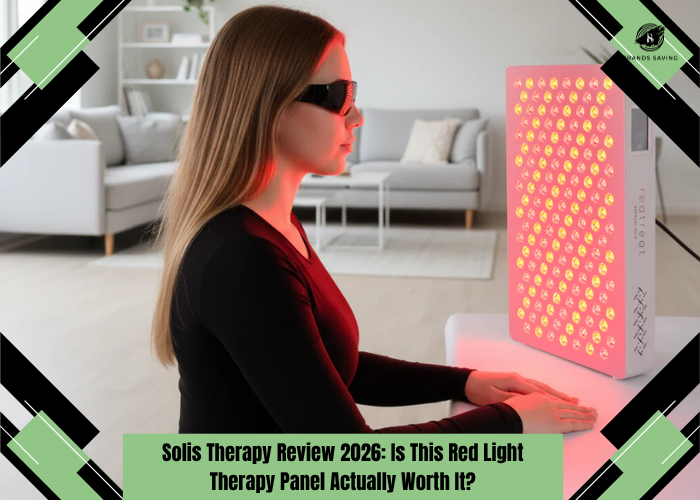
Solis Therapy Review 2026: Is This Red Light Therapy Panel Actually Worth It?
Red light therapy has moved from clinics and biohacking podcasts into normal homes. People are buying panels for skin appearance, muscle recovery, joint stiffness, sleep routines, and general wellness. But with so many devices making similar claims, it is fair to ask a simple question: is Solis Therapy legit, or is it another expensive wellness trend?
This Solis Therapy review looks closely at the brand, the Solis Spectrum SOLO 2.0, customer feedback, pricing, value, competitors, and discount options. I’ll also cover what Solis does well, where it may disappoint, and who should probably skip it. Solis lists the Spectrum SOLO 2.0 as a compact targeted red light panel with 60 high-powered LEDs, five red and near-infrared wavelengths, approximately 180 mW/cm² irradiance at 6 inches, a 90-day money-back trial, free express shipping, and a 3-year warranty. Its current sale price is shown as £399, reduced from £599, though prices and discount codes can change.
Quick Verdict Box
| Category | Verdict |
| Overall Rating | 8.7/10 |
| Best For | People wanting a premium targeted red light therapy panel for face, joints, recovery, sleep routine, and wellness support |
| Pros | Strong specs, five wavelengths, compact design, 90-day trial, 3-year warranty, positive Trustpilot rating |
| Cons | Not cheap, results require consistency, not a full-body panel, some users may not notice dramatic changes |
| Short Summary | Solis Therapy is a strong option if you want a well-built, targeted red light panel with better-than-basic specs and a generous trial period. It is not magic, but it offers good value for serious home users. |
What Is Solis Therapy?
Solis Therapy is a wellness technology brand focused on red light and near-infrared light therapy devices for home use. The company positions its panels as clinical-grade tools designed to support recovery, skin appearance, mood, sleep, and general wellbeing. The product most buyers will likely consider first is the Solis Spectrum SOLO 2.0. It is the targeted model in the Spectrum 2.0 lineup and is designed for smaller treatment areas such as the face, neck, shoulders, knees, joints, and localized muscle soreness. Solis states that the SOLO 2.0 covers around 2–3 square feet per session and is better for focused use rather than full-body treatment. The brand also sells larger models such as SURGE 2.0 and SUPREME 2.0. The SUPREME 2.0 is listed as a larger 308-LED panel intended for broader muscle recovery and skin rejuvenation sessions. Solis Therapy is best suited for people who want a dedicated at-home device rather than paying for repeated clinic sessions. The main audience includes fitness users, people with stiffness, skincare-focused buyers, biohackers, wellness enthusiasts, and anyone building a consistent recovery routine at home.
Key Features of Solis Therapy
Five Red and Near-Infrared Wavelengths
One of the strongest points in this Solis red light therapy review is the wavelength range. The SOLO 2.0 uses visible red light at 630nm and 660nm, plus near-infrared light at 810nm, 830nm, and 850nm. Solis lists this five-wavelength setup directly in the product specifications. Red wavelengths are commonly used for more surface-level goals such as skin appearance, while near-infrared wavelengths are often used for deeper tissue support. This does not mean every user will see the same outcome, but it does make the device more versatile than basic two-wavelength panels.
60 High-Powered LEDs
The Solis Spectrum SOLO 2.0 includes 60 x 5W LEDs. That puts it in the compact targeted panel category, not the full-body category. For face, neck, knees, elbows, shoulders, and smaller recovery zones, that size makes sense. For someone wanting to treat their whole back or legs in one session, the SOLO 2.0 will feel limited. This is where many buyers make the wrong choice. The SOLO 2.0 is not a bad panel; it is simply a targeted panel. If you expect full-body coverage, you should consider larger Solis models or a competitor’s larger panel.
Claimed Irradiance of Around 180 mW/cm²
Solis claims approximately 180 mW/cm² irradiance at 6 inches for the SOLO 2.0. That is a strong advertised output for a compact red light panel. In plain English, irradiance refers to how much light energy reaches a specific area. Higher output can make sessions more efficient, but dosage still matters. More is not always better. Red light therapy often works best when used consistently and sensibly rather than aggressively.
Low EMF and Flicker-Free Design
The SOLO 2.0 product page states that the device is flicker-free and has 0 EMFs, with safety features listed in the technical specifications. This matters because wellness buyers are often cautious about placing high-powered devices close to the body. Low EMF claims are common in this category, but it is still good to see Solis making safety part of the product positioning.
90-Day Money-Back Trial
A big trust factor is the 90-day money-back trial. Solis says buyers can return the panel for a full refund if they do not see results, and the product page also highlights a 3-year warranty. That does not guarantee results, but it reduces buyer risk. Red light therapy is a habit-based product. Some people notice changes in sleep or stiffness quickly, while skin and recovery benefits can take longer.
Free Accessories and Usage Guide
The SOLO 2.0 listing includes free blue light blocking glasses and a bespoke usage guide. This is useful for beginners because one of the biggest mistakes with red light therapy is inconsistent or incorrect use. A proper guide can help people understand distance, timing, treatment areas, and realistic expectations.
First Impressions
The first impression of Solis Therapy is premium but approachable. The panels have a clean, minimal design and come in black or white, which makes them easier to fit into a bedroom, home gym, or office space. The SOLO 2.0 is not tiny, but it is compact enough to move around. At 34.5cm x 23cm x 9.5cm and 4.5kg, it feels more like a serious home device than a small beauty gadget. Setup should be straightforward for most users. The main process is choosing the treatment area, placing the panel at the right distance, wearing eye protection when needed, and using it consistently. Solis recommends a daily routine of around 10 minutes for targeted results on its product page. The initial expectation should not be “instant transformation.” A better expectation is gradual support. If you are using it for skin quality, recovery, stiffness, or sleep routine, it is more like brushing your teeth or stretching than taking a pill.
Performance and Real-World Experience
The biggest strength of Solis Therapy is convenience. Instead of booking red light therapy appointments or visiting a wellness clinic, you can use the panel at home. That matters because consistency is one of the main factors in whether a red light panel feels worthwhile. For skin-focused buyers, the SOLO 2.0 makes the most sense around the face, neck, and chest. Red light therapy research is still developing, but LED light therapy is commonly discussed for skin texture, redness, wrinkles, acne, and collagen support. Cleveland Clinic notes that LED light therapy may help reduce and improve some skin issues, but regular treatment is needed to see improvement. For recovery-focused users, the panel is more useful for localized areas: knees after running, shoulders after lifting, lower neck tension, or specific sore points. It is not large enough to treat the entire body efficiently, but it works well for focused routines.
For sleep and mood routines, many users like using red light in the evening because it feels calming compared with harsh overhead lighting. That said, it should not be marketed as a sleep cure. Think of it as part of a wind-down ritual. The main weakness is that results vary. Some people feel changes in a few weeks. Others may use a panel several times per week and not notice enough difference to justify the price. Public feedback reflects both sides: Trustpilot reviews are mostly positive, but at least one reviewer reported no noticeable skin or hair results after several months of consistent use.
Pricing and Value Analysis
At the time checked, the Solis Spectrum SOLO 2.0 is listed at £399, down from £599. Solis also displays discount-code messaging on the product page, including codes such as SOLSTICE, SPRINGSOL, and VIPSPRING in different on-page sections, so buyers should verify the live working code at checkout before publishing any fixed “Solis Therapy discount code” claim. In value terms, Solis sits in the premium-but-not-outrageous category. It costs more than entry-level budget panels like Hooga’s HG line, which starts at $149, but it is far cheaper than larger high-end systems like Joovv Solo 3.0, currently listed at $1,699.
Compared with MitoPRO 300X at $449, Solis SOLO 2.0 is in a similar targeted-panel bracket, though Mito offers six wavelengths and third-party testing information, while Solis emphasizes strong irradiance, five wavelengths, and a longer 90-day trial. Is the premium justified? For a casual buyer who may use it twice and forget it, no. For someone who plans to use red light therapy 4–5 times per week, the value becomes much stronger.
Pros and Cons Table
| Pros | Cons |
| Five red and near-infrared wavelengths | SOLO 2.0 is not ideal for full-body sessions |
| Strong advertised irradiance | Premium price compared with budget panels |
| 90-day money-back trial | Results require consistent use |
| 3-year warranty | Some users may not notice major changes |
| Compact and easy to use at home | Discount code messaging may vary by campaign |
| Positive Trustpilot profile | Health claims should be treated realistically |
Who Should Buy Solis Therapy?
Solis Therapy is a good fit for people who already understand that red light therapy is a consistency-based wellness tool. If you want a compact device for your face, joints, shoulders, neck, or post-workout soreness, the SOLO 2.0 is a practical choice. It is also a smart option for buyers who want a trial period. The 90-day money-back guarantee gives you enough time to test whether the device becomes part of your routine.
| User Type | Recommendation |
| Skincare-focused buyer | Good fit |
| Runner or gym user | Good for targeted recovery |
| Full-body wellness user | Consider larger Solis model |
| Budget shopper | Compare with Hooga |
| Tech-heavy buyer | Compare with MitoPRO or PlatinumLED |
Who Should Avoid It?
You should avoid Solis Therapy if you expect overnight results. Red light therapy requires patience, and even then, results are not guaranteed. You may also want to skip the SOLO 2.0 if your main goal is full-body coverage. For that, a larger panel such as Solis SURGE 2.0, Solis SUPREME 2.0, MitoPRO 1500X, or PlatinumLED BIOMAX 600/900 may make more sense. People with light-sensitive medical conditions, those taking photosensitizing medication, or anyone dealing with serious pain or skin disease should speak with a healthcare professional before using red light therapy.
Customer Feedback Summary
Solis Therapy reviews are generally positive. Trustpilot currently shows an Excellent rating of 4.8/5 from 119 reviews, with 91% of reviews listed as 5-star. Trustpilot also notes that the company has not invited customers, reviews may not be representative, and Solis replies to 100% of negative reviews, typically within 24 hours. Positive themes include improved sleep, better skin appearance, reduced stiffness, customer service, and helpful usage advice. Negative themes are less common but include delayed delivery, users not seeing results, and isolated customer service frustrations. Reddit discussion around Solis appears more exploratory than conclusive. Some users ask whether Solis is good compared with UK brands like Helios or Red Light Man, but Reddit does not currently provide enough consistent evidence to treat it as a reliable review source.
Competitor Comparison
| Brand / Model | Best For | Starting Price Checked | Wavelengths | Warranty | Main Difference |
| Solis SOLO 2.0 | Targeted home use | £399 sale | 5 | 3 years | Strong targeted panel with 90-day trial |
| MitoPRO 300X | Tech-focused targeted users | $449 | 6 | 3 years | More wavelengths and third-party testing |
| Hooga HG Series | Budget buyers | From $149 | 2 | 3 years | Affordable but simpler specs |
| Joovv Solo 3.0 | Premium modular setup | $1,699 | 2 | 2 years | High-end ecosystem, much higher price |
| PlatinumLED BIOMAX 300 | Advanced spectrum users | $659 | 7 | 3 years | More wavelengths and larger control system |
MitoPRO X is arguably the closest direct competitor for a targeted panel. It has six wavelengths and strong technical transparency. Hooga is better for budget shoppers. Joovv is more premium and expensive. PlatinumLED is attractive for buyers who want a more advanced spectrum and do not mind paying more.
FAQs
Is Solis Therapy legit?
Yes, Solis Therapy appears to be a legitimate red light therapy brand. It sells physical red light panels, provides technical specifications, offers a 90-day money-back trial, and has an Excellent Trustpilot rating from public reviewers.
Is Solis Therapy worth it?
Solis Therapy is worth it if you want a quality targeted red light panel and will use it consistently. It is less worth it for casual users or people expecting instant results.
What is the Solis Spectrum SOLO 2.0?
The SOLO 2.0 is a compact red light therapy panel with 60 LEDs, five wavelengths, and targeted coverage for areas such as the face, neck, shoulders, knees, and joints.
Does Solis Therapy help with skin?
It may support skin appearance as part of a consistent routine, but results vary. LED light therapy has been discussed for improving some skin issues, but regular treatment is usually needed.
Does Solis Therapy help with pain?
Some users report relief from stiffness or localized discomfort, but Solis Therapy should not be treated as a medical cure. Speak to a healthcare professional for ongoing pain.
What is the Solis Therapy discount code?
Solis displays rotating discount messaging on its site, including codes such as SOLSTICE, SPRINGSOL, and VIPSPRING in different sections. Check the current checkout page before publishing or using any code.
How long does it take to see results?
Some users report changes within weeks, while others need longer or may not notice major results. Consistency matters.
Is Solis better than Hooga?
Solis is more premium than Hooga’s entry-level panels. Hooga is better for budget buyers, while Solis is better for users who want stronger specs and a longer trial.
Is Solis better than Joovv?
Solis is usually much cheaper than Joovv. Joovv has a premium modular ecosystem, while Solis offers strong value for home users.
Does Solis Therapy have a warranty?
Yes, Solis lists a 3-year comprehensive warranty for the SOLO 2.0.
Final Verdict
Solis Therapy is one of the more convincing red light therapy brands in the home wellness space. The SOLO 2.0 offers a strong mix of five wavelengths, compact design, targeted coverage, a 90-day trial, and a 3-year warranty. It is best for people who want a serious at-home red light panel for targeted use. It is not ideal for shoppers who want the cheapest possible panel or full-body coverage from one device
At BrandsSaving, we are dedicated to helping you shop more intelligently, spend more judiciously, and find superior value online. Regardless of whether you are a student, a parent, a fashion enthusiast, or just a sensible shopper, we link you to dependable savings opportunities and trustworthy buying options from your preferred brands across the globe
Subscribe
Sign up below to receive money-saving tips, frugal ideas, family-friendly recipes, and more.